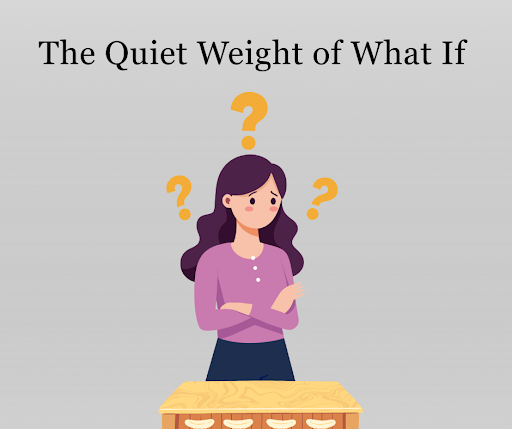
After the loss of a loved one, we often have so many questions that have no answers. Our minds become cluttered with all the different scenarios that “could have” happened. Often, these questions don’t have answers.
What if I had noticed sooner?
What if I had said something different?
What if we had chosen another path, another doctor, another moment in time?
These thoughts can circle quietly or arrive all at once, carrying the heavy weight of would-have, could-have, and should-have happened. These are the things that “might have” changed the outcome of that day or time.
These thoughts can circle quietly in the background or arrive all at once, carrying the heavy weight of would-have, could-have, and should-have.
For many widows, the what-ifs begin almost immediately. In the stillness after the hospital, after the calls, after the meals stop arriving, the mind starts searching backward. It looks for the moment where something might have changed the ending. It replays conversations. It studies decisions. It questions instincts.
This does not happen because we are being hard on ourselves. It’s grief trying to make sense of what feels senseless.
The What-Ifs Are a Normal Part of Grief
The what-ifs are not a sign that you did something wrong. They are part of how grief processes loss. When someone we love dies, our minds naturally search for reasons, patterns, and alternate endings. It’s one way the brain tries to regain control after something that felt completely out of our control. It’s part of the Kubler-Ross stages of grief called bargaining.
In many ways, the what-ifs are the mind’s attempt to rewrite the story so it doesn’t hurt so much.
Our brain is trying to help us by reasoning that if I can find the key moment, I might understand it. If I can understand it, maybe I can live with it.
But most of the time, there are only more questions.
What the What-Ifs Might Sound Like for you
For some, they sound like:
- What if I had pushed harder for another test?
- What if I hadn’t complained that day?
- What if I had noticed the symptoms sooner?
- What if we had gone to a different hospital?
- What if I had told them one more time how much I loved them?
Sometimes they sound softer:
- What if I had just sat with them longer that night?
- What if I had known it was the last time?
These thoughts often come not from guilt, but from love. They come from wishing we could have protected the person we cared about most.
What they Sounded Like for us:
Teresa’s What-Ifs
The what-ifs arrived loudly and begged to make sense of Kris’s death almost immediately. I kept replaying moments that once felt ordinary and seemed so important. What if he took a different route, left earlier, took the truck? I remember just not being able to wrap my head around the why, how, and endless what-ifs. I spent many hours on our front porch staring out into nature seeking answers that never came. I eventually came to understand the answers were not relevant; they wouldn’t bring him back or change the circumstances. I eventually came to peace with not knowing and accepting my new reality as a widow.
- What if he didn’t ride his motorcycle?What if he suffered?
- What if we hadn’t yelled at the kids the night before?
- What if I insisted he sell the damn motorcycle?
Jeni’s What-Ifs
I know the what-ifs personally. After my husband died, there were moments I replayed over and over, conversations, decisions, small details that suddenly felt enormous. I remember wondering if I had missed something, if I could have done something differently, if one tiny change might have altered everything. Over time, I’ve learned that those questions didn’t come from failure. They came from love. And slowly, I’ve had to learn to offer myself the same grace I would offer anyone else walking through loss. If you carry those questions too, please know you are not alone. I slowly came to realize that none of these questions would change what had happened and that I had to accept his loss.
Even so, here are some of the questions that I struggled with:
- What if we had met for lunch that day as we had discussed?
- What if I had known he had a heart condition?
- What if we had changed our diet?
- What if he had gone to the doctor?
- What would have happened if the kids hadn’t gone to the game?
- What if our last conversation hadn’t ended with “I Love You”?
Why the What-Ifs Feel So Heavy
Living with the what-ifs can be exhausting. They replay moments we cannot change and quietly ask us to take responsibility for outcomes that were never fully within our control.
They create the illusion that if we had just known more, seen more, or done more, the ending might have been different. But grief often forgets one important truth:
We only ever make decisions with the information we have in the moment. Not with the clarity we gain afterward.
Hindsight is loud.
Love is louder.
But blame is often the voice that tries to fill the silence.
One thing to remember is that, no matter how many what-ifs you have, they will not change what has happened. Unfortunately, you still have the loss and the grief journey to travel. We hope this information makes your journey just a little easier.
Learning to Set Some Questions Down
Over time, many widows discover that peace does not come from answering every question. It comes from gently setting some of them down. Allowing some questions to remain unanswered and being OK with that. We can set them down, not because they don’t matter, not because the love wasn’t real, or that we’re forgetting. We set them down and leave them unanswered because carrying every unanswered question forever is too heavy for any heart, mind, or soul. By doing this, we allow ourselves to live forward without trying to solve what cannot be solved.
A Gentle Reminder
If the what-ifs visit you, you are not failing at grief. You are human, and it’s normal. You loved someone who mattered deeply. When the questions feel too heavy, it is okay to pause them. It is okay to remind yourself that you did the best you could with what you knew at the time. You loved the best way you knew how and showed up in ways only you could.
Offer yourself the same compassion you would give anyone else living through unimaginable loss.
Because grief will always have questions, and healing often begins when we stop demanding answers and start the process of accepting what happened.
With peace and blessings,
Jeni & Teresa
Resources to Support You
The First Days: Coping with Life After Loss – for those in early grief
My Journey as a Widow: A Widow’s First Journal – for reflection and healing
10 Ways to Move Forward After Loss – free download
Visit us at www.torninhalf.com or connect with us on
Facebook & LinkedIn