There comes a point in many grief journeys when the questions have softened, the sharpest edges of guilt are not quite as loud, and the days begin to hold small moments of steadiness again. Yet even then, a new kind of struggle can appear.
It is the quiet tension between remembering the life that was, figuring out life as it is now, and trying to find your way into your future.
Many people discover that moving forward is not always as simple as they once imagined. It can come with unexpected emotions. A moment of laughter may be followed by sadness. Enjoying a new experience may stir discomfort. Feeling hope again may bring an ache that is difficult to explain.
Some begin to wonder:
Am I leaving them behind?
Does building a new life mean the old one mattered less?
If I feel joy again, what does that say about my love?
If I move forward, am I somehow rewriting what we had?
These thoughts are more common than many realize. They often arise because grief is not only about losing a person. It is also about losing a shared identity, routines, future plans, and the version of life that once felt certain. When we begin to move forward, we realize that we have to recreate many parts of our lives. As we do the necessary rebuilding, it can feel as though we are stepping away from something sacred.
But living forward does not require rewriting or forgetting the past. This part of our life becomes part of our story. We can find ways to incorporate these memories and stories into who we are and who we are now becoming.
Moving forward does not erase the love you shared. It doesn’t cancel the years you built together. It doesn’t diminish the memories, the struggles, the laughter, or the life that was real and meaningful. The past remains true, even as a new, unexpected life continues to unfold.
Sometimes grief quietly convinces us that staying stuck is a form of loyalty. That if we remain in pain, we are honoring what was lost. That if we do not fully reengage with life, we are proving how much the relationship mattered.
Yet love has never asked us to stop living.
Grief can sometimes quietly convince us that remaining in pain is proof of devotion. It can whisper that if we laugh again, make plans again, or feel joy again, we are somehow leaving behind the person we lost. Many carry the unspoken belief that staying stuck is a way of showing how much they care. Yet love has never required suffering as evidence of its depth.
Real love does not ask us to abandon the life still in front of us. It does not demand that we shrink, isolate, or refuse moments of happiness in order to remain loyal. Love, in its healthiest and truest form, wants good for the one who carries it. It desires peace, healing, and continued life, even after loss.
The relationship you shared was made up of living moments. Conversations, routines, laughter, struggles overcome together, quiet evenings, and hopes for tomorrow. Those memories were rooted in life, not in permanent sorrow. To continue living is not a rejection of that love. In many ways, it is an extension of it.
Sometimes we imagine that moving forward means moving away. But often, moving forward simply means carrying love into new spaces. It means using what was learned in the relationship to shape how we live now. Kindness offered to others, courage in difficult seasons, appreciation for ordinary moments, deeper empathy for pain, and gratitude for the time once shared can all become expressions of continuing love.
Love can remain present without requiring life to remain frozen.
You do not honor someone only by mourning their absence. You also honor them by valuing the life that still remains in you. By caring for yourself. By allowing joy when it comes. By taking opportunities that they may have wanted for you. By laughing at memories instead of only crying over them. By continuing to grow, even when growth feels unfamiliar.
There may still be sadness. There may still be tears. Continuing to live does not mean grief disappears. It means grief no longer gets to define every step. The heart can hold remembrance and renewal at the same time.
Yet love has never asked us to stop living. Often, if love could speak clearly, it might say the opposite: Keep going. Carry me with you. Live fully with the love we created.
Those we love are deeply meaningful chapters in our story. They are not the closing page.
Carrying their memory forward may look less like standing still and more like living in ways that reflect what mattered most.
- Showing kindness because they valued kindness.
- Traveling somewhere you once dreamed about together.
- Laughing again without apologizing for it.
- Creating new routines while still treasuring old memories.
- Loving deeply in the world because you once loved deeply.
There is no betrayal in healing and moving forward.
There is no disloyalty in experiencing peace.
There is no failure in building something meaningful.
The heart is capable of holding more than one truth at a time. You can miss someone deeply and still feel gratitude. You can carry sorrow and still welcome joy. You can honor the past and still make room for the future. You can love someone who is gone and still love again.
Often, moving forward happens quietly. It is not one dramatic moment. It happens when you make plans again. When you laugh without immediately feeling guilty. When you notice a memory and smile more than cry. When you allow yourself to care about what comes next.
These moments do not mean you have forgotten.
They often mean you are ready to keep living.
The life you had deserves to be honored. The life still before you deserves care and attention as well. These two realities are not in conflict. You do not have to choose between remembering what was and embracing what remains. They often exist side by side from the very beginning, as grief carries love for the past, while life quietly continues to ask for your presence in the present.
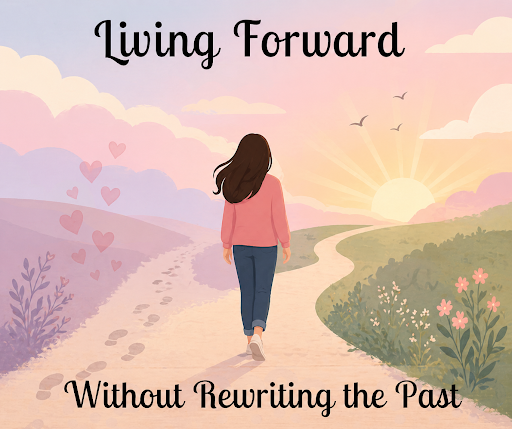
Living forward without rewriting the past means allowing your story to keep going while trusting that the chapters behind you remain important, loved, and true.
With peace and blessings,
Jeni & Teresa
Resources to Support You
The First Days: Coping with Life After Loss – for those in early grief
My Journey as a Widow: A Widow’s First Journal – for reflection and healing
10 Ways to Move Forward After Loss – free download
Visit us at www.torninhalf.com or connect with us on
Facebook & LinkedIn