There seems to be a point in grief when the world begins to expect something from you. It may not happen right away. At first, people understand that you are grieving. They check on you, ask how you are doing, and give you permission to be sad. But as the months pass, and especially as the years pass, something can begin to change. The calls may become less frequent. Conversations about the person you lost may become shorter. Someone may say, “It’s been a while now,” or suggest that it is time to start dating, make a fresh start, or focus on the future.
Sometimes, no one says anything at all. You simply begin to feel it. There is an expectation that, by now, you should no longer be grieving. You should be moving on. You should be over it. We call this the Get Over It Syndrome.
Neither of us can remember anyone actually looking at us and saying, “Get over it.” Most people would never be that cruel. Instead, the message often comes in quieter ways. It can be the person who becomes uncomfortable when you mention your husband’s name, the conversation that quickly changes when you share a memory, or the surprise on someone’s face when you admit that a particular day was difficult, even though years have passed. The message may not be intentional, but the grieving person can still hear it clearly: Shouldn’t you be past this by now?
But what does “past it” really mean? When your spouse dies, you not only lose the person you loved. You lose the life you shared with that person. You lose the routines that belonged to the two of you, the conversations no one else heard, the plans you made, the inside jokes, the traditions, and the person you turned to with good news, bad news, and all the ordinary news in between. You also lose the version of yourself that existed within that marriage.
How do you simply get over that?
The answer, at least for us, is that you don’t. You learn. You change. You adapt. You discover things about yourself that you never wanted to have to learn. You make decisions you never expected to make alone. You find ways to keep living when the life you thought you would have is no longer possible.
Over time, you may laugh more than you cry. You may build new relationships, create new traditions, travel to new places, and discover new parts of yourself. Life can become full again, but none of that requires you to forget the life that came before. Moving forward and remembering are not opposites.
Both of us have experienced this in different ways. We have continued living. We have grown. We have loved people, welcomed grandchildren, celebrated milestones, faced challenges, and created memories that our husbands were not here to see. And still, Bob is part of Jeni’s story, and Kris is part of Teresa’s story. That does not change because time has passed.
There are still television shows that remind Jeni of Bob. There are still songs that take Teresa immediately back to a memory of Kris. There are family moments when we think about the people who should be there, and times when we wonder what they would say about the lives we are living now. Those memories do not mean we have failed to move forward. They mean that someone mattered, and that the lives we shared with them continue to be part of who we are.
Sometimes, the pressure to appear “over it” is never spoken. Grieving people can begin to feel as though they need to protect everyone else from their grief. We may smile when we do not feel like smiling. We may say, “I’m fine,” because the real answer feels too complicated. We may stop sharing stories because we sense that others have heard them before. In some ways, we can become very good at looking okay, but looking okay and being okay are not always the same thing.
There is also something we wish more people understood. Continuing to love and remember someone who died does not prevent us from living. We can hold both. We can be grateful for the life we have today and still miss the life we had before. We can love the people who are part of our lives now without diminishing the love we had for someone who died. We can create new memories without erasing old ones.
Grief and joy are not always opposites. Sometimes they sit beside each other. A family celebration can be wonderful, and we can still notice who is missing. A grandchild can make us laugh, and we can still wish their grandfather were there to see it. A new chapter of life can be meaningful and beautiful while we continue to honor the chapters that came before.
Perhaps that is what moving forward really looks like. It is not leaving someone behind, pretending the loss did not change us, or reaching a point where we never feel sadness again. Instead, we learn how to build a life that has room for what was, what is, and what is still becoming.
If you love someone who is grieving, you don’t need to push them toward the future. You do not need to find the right words or encourage them to stop looking backward. Listen when they tell a story, even if you have heard it before. Say their loved one’s name. Understand that an anniversary may still be difficult years later. Allow happiness and sadness to exist in the same conversation, and please do not measure someone’s grief by a calendar.
We have both learned that grief has its own rhythm. Some days, the person we lost feels very far away. On other days, one small thing can bring them close again. It might be a song, a photograph, a familiar saying, a family milestone, or an ordinary Tuesday when, for no obvious reason, we simply miss them.
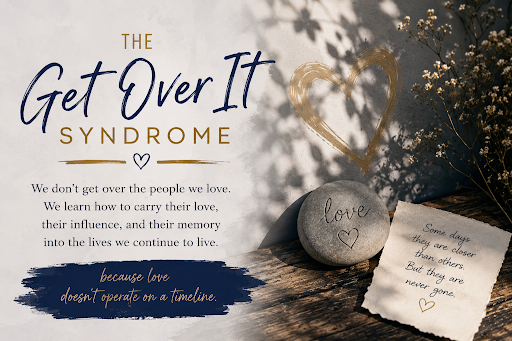
We are not trying to get over the people we loved. We are learning how to carry their love, their influence, and their memory into the lives we continue to live. A better question is not, “When will you get over it?” It’s, “How are you learning to live with it?”
Those are two very different questions. One asks grief to disappear. The other makes room for the person who is grieving to keep growing, changing, remembering, and living.
And sometimes, making room is exactly what we need.
A reflection for you:
Have you ever felt pressure to be further along in your grief than you really were? What do you wish the people around you had understood?
With peace and blessings,
Teresa & Jeni
Resources to Support You
The First Days: Coping with Life After Loss – for those in early grief
My Journey as a Widow: A Widow’s First Journal – for reflection and healing
10 Ways to Move Forward After Loss – free download
Visit us at www.torninhalf.com or connect with us on
Facebook & LinkedIn