When your spouse dies, the loss reaches far beyond your own heart. It changes how our lives function and the relationships we share with our loved ones.
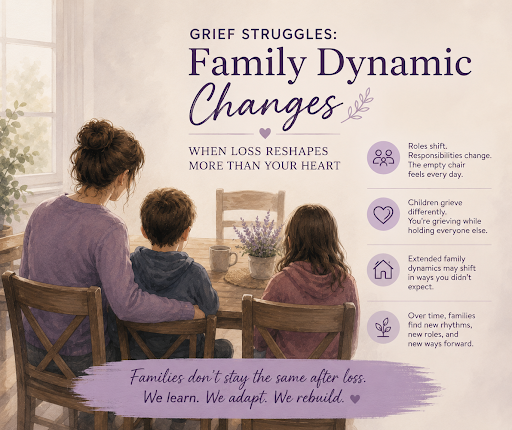
When we lose someone in our lives, it is not just the person that we lose. Our family becomes disrupted. We lose routines, balance, shared responsibilities, and the quiet ways two people carried life together. Widowhood brings not only emotional grief to our lives. It also brings a form of structural grief. In a moment, the family’s entire rhythm changes.
Some of those changes are obvious. Others show up slowly in everyday moments.
The person who handled certain finances is no longer there. The one who remembered birthdays, kept traditions going, settled disagreements, fixed problems, or helped carry difficult decisions is suddenly missing from the flow of daily life. And while the grief itself is already heavy, the reality is that those responsibilities do not disappear. They simply shift. Suddenly, there is nobody left to share the responsibilities and daily chores, joys, and celebrations of life.
All of it becomes ours to do, ours to complete, ours to plan, ours to celebrate.
The empty chair at the table becomes more than a symbol of loss. It represents the absence of partnership, shared leadership, and the sense that someone else was helping hold the family together with you.
Children feel these changes too, although they do not always know how to express them. Some become overly responsible. Some grow quieter. Others act out, cling more tightly, or avoid talking about the parent who died altogether. Grief moves differently for each person in the home, which can leave families feeling disconnected from one another even as they grieve the same loss. Know that having different grief journeys occurring simultaneously is normal and a part of grief.
At the same time, the surviving spouse is often trying to juggle multiple roles. You are grieving your partner while also attempting to be the emotional anchor for everyone else. There can be pressure to stay strong, make every decision, protect the children, manage the emotions of extended family members, and somehow keep life functioning when your own world no longer feels steady. You may feel like you have to grieve for your children when, in fact, you cannot do the grieving for them. That is their own journey, and just like you have to travel your journey in your way, so do they.
The emotional weight of grief, combined with the shifts that happen within a family after loss, can be exhausting in ways that are difficult to explain to anyone who has not lived through it.
Loss can also change extended family relationships. Sometimes grief draws people closer. In-laws may step in more strongly or step back entirely. Siblings may offer advice that feels helpful or overwhelming. Other times, it exposes tensions that were already there beneath the surface. Traditions may suddenly feel emotionally complicated. Advice may come when it is not wanted. Expectations around “moving forward” may not match from one person to another. And underneath all of it is another quieter shift that many widows feel deeply:
You are no longer a “we.” This means you may have to redefine your life as ‘me’ or ‘I’.
Where there were once shared conversations and mutual decisions, there is now one voice carrying responsibilities that used to belong to two people. Even identity begins to shift. Wife becomes a widow. Partner becomes solo decision-maker. You become the head of the household, holding everything together.
Many times, this almost sudden transition feels less like a choice and more like something forced upon you before you were ready. It becomes a time when you have to find ways to adapt and find ways to handle all of the things.
There can also be pressure to keep everything the same for the sake of the family. To preserve traditions exactly as they were. To protect others from your sadness. To hold everything together in the same way it always was.
Grief has already changed the family.
Sometimes healing begins when we stop expecting life to look exactly the way it once did.
You will probably find, as we both have, that keeping everything the same is simply not possible, nor is it feasible. You will begin to decide what is important to keep and hold onto and what is ok to let go. It will take time, but you will move forward and grow in the process as you decide what you want to keep.
Over time, many families begin to find a new rhythm. A new rhythm that acknowledges the loss while still making space for growth, connection, and healing over time.Not because the loss disappears, but because love starts learning how to exist alongside change. Roles evolve. Traditions adapt. Conversations become more open and honest. Little by little, families begin rebuilding around the space left by loss. We can let go of the expectations of perfection and of doing it “right”. We begin doing what works best for us and what fits in our lives.
Not replacing the person who died. Not moving on from them. We begin learning how to move forward while carrying them differently with us.
If your family feels different after loss, that does not mean you are failing.
It means someone important is missing.
And that kind of love always leaves an imprint.
Know that you are not alone.
With peace and blessings,
Jeni & Teresa
Resources to Support You
The First Days: Coping with Life After Loss – for those in early grief
My Journey as a Widow: A Widow’s First Journal – for reflection and healing
10 Ways to Move Forward After Loss – free download
Visit us at www.torninhalf.com or connect with us on
Facebook & LinkedIn