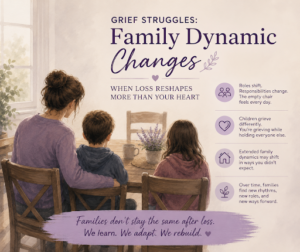
One of the surprising things about grief is that even when people experience the same loss, they rarely experience it in the same way. We sometimes assume that because we loved the same person, our grief should look similar. But anyone who has experienced a loss within a family has probably discovered that isn’t necessarily true.
The same death can leave one person wanting to talk for hours while another becomes quiet. One person may find comfort in looking through photographs, while someone else may not be ready to look at them at all. One family member may return to work quickly because routine helps them cope, while another struggles to make it through an ordinary day. These differences don’t make one person’s grief more meaningful than another’s. They are simply different ways of living with the reality that someone we love is no longer physically here.
We often see those differences between adults and children. As adults, we may grieve not only the person who died, but also the future we imagined with them, the responsibilities they carried, and the countless ways they were woven into our everyday lives. Along with the sadness can come very practical concerns about finances, family, routines, and all of the decisions that suddenly have to be made. Somehow, life keeps asking things of us even when we aren’t sure we have anything left to give.
Children experience the loss from their own place in the relationship. They haven’t lost a spouse or life partner. They may have lost a parent, grandparent, sibling, or another important person whose place in their life was uniquely theirs. Their grief may not look the way adults expect it to. A child may cry one moment and then ask to ride a bike or play a game the next. They may ask the same question again and again. Some children may act out and others may go quiet, both are ways of grieving. Sometimes what they are feeling may show up in their behavior, sleep, or schoolwork rather than in ways we immediately recognize as grief. That can be difficult for grieving adults to understand, especially when we are trying to make sense of our own loss at the same time.
One of the things our own experiences have taught us is that one death can create many different experiences of grief. When our husbands died, we grieved the loss of our life partners and the lives we had built together. But we weren’t the only ones grieving. Our children had lost their dads. Their parents had lost their sons. Siblings had lost brothers, and friends had lost someone who held a place in their lives that was different from the place he held in ours. We were all grieving the same person, but we weren’t grieving the same relationship. Each of us had our own memories, our own connection, and our own loss. It makes sense, then, that our grief wouldn’t look exactly the same.
All of those different ways of grieving can get messy. When one person needs to talk and another needs silence, or one person wants to hold onto everything while someone else is ready to make changes, it can be hard to understand each other. We may even feel hurt or frustrated by the way someone else is grieving, especially when we are carrying so much of our own pain. Grief doesn’t always bring people together in the ways we might expect. Sometimes we have to learn how to give each other room to grieve differently, even when we don’t understand it.
Every relationship has its own history, memories, routines, expectations, inside jokes, disappointments, dreams, and ordinary moments that no one else completely shared. Those differences don’t end with families or with age. Even two widows will not experience widowhood in exactly the same way because no two marriages, no two lives, and no two losses are exactly alike. In our experience, we have found that each grief journey is as unique as the relationship it represents.
Who we are also comes with us into grief. Some of us need to talk, while others need quiet before we can begin to put words around what we are feeling. Some stay busy because movement helps them get through the day, while others need the world to slow down for a while. Our families, our faith, our culture, our previous experiences with loss, and what we learned about showing emotion can all become part of the way we experience grief. We don’t come to grief without a history. We bring who we are and what we have already lived with us.
Sometimes the pressure doesn’t come from within us at all. It comes from the people around us and from the messages we have heard about what grief is supposed to look like. We may be expected to move forward before we are ready, or questioned when we begin to laugh, travel, date, make changes, or find moments of happiness again. People may have their own ideas about how long grief should last, what we should keep, when we should make decisions, or even how often we should talk about the person who died. Those expectations can leave us feeling as though we need to make our grief fit into something other people are more comfortable with, rather than allowing it to be what it is for us.
Perhaps that is why comparing grief can be so difficult and so unfair. We look at someone else and wonder why we aren’t doing as well as they seem. We wonder why we are still struggling years later or why our children seem to have adjusted more quickly than we have. We may even find ourselves questioning why another family member doesn’t seem to be grieving the way we think they should. Before long, those comparisons can leave us wondering whether we are somehow doing grief wrong.
Over the years, we have come to believe that one of the greatest gifts we can give ourselves and the people we love is permission to grieve honestly and in our own way. That may mean laughing without guilt, crying without apology, remembering differently, or simply accepting that today may not look anything like yesterday. It also means giving the people we love that same freedom, even when their grief looks very different from ours.
When we stop measuring our grief against someone else’s, we can begin to make more room for compassion. Instead of wondering why someone isn’t grieving the way we are, we can remember that their relationship with the person who died was their own. Their grief doesn’t need to look like ours in order for their love or their loss to be real.
Perhaps that is one of grief’s quiet truths. We may share the loss of the same person, but we will never experience that loss in exactly the same way. Every relationship is unique, which means the grief connected to that relationship will be personal too. Maybe what we owe ourselves, and one another, is the space to let each of those stories unfold in its own way.
With peace and blessings,
Teresa & Jeni
Resources to Support You
The First Days: Coping with Life After Loss – for those in early grief
My Journey as a Widow: A Widow’s First Journal – for reflection and healing
10 Ways to Move Forward After Loss – free download
Visit us at www.torninhalf.com or connect with us on
Facebook & LinkedIn