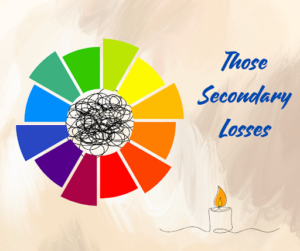
One thing we have learned over the years is that everyone seems to have an idea of what grief should look like. Some people think of it as a series of stages that eventually lead to acceptance. Others believe there comes a point when you should simply move on or “get over it.” Most of these ideas come from a desire to understand grief or to help someone through it, but for many of us who have lived the loss of a spouse, the reality feels much different.
Our experience has never been that grief ends. It changes.
In the beginning, grief can consume every part of life. Every decision feels heavier. Every holiday feels different. Every quiet moment reminds you of the person who is no longer there. It is hard to imagine life ever feeling anything other than broken. Those early days often leave us wondering whether we will ever feel like ourselves again.
As time passes, something begins to shift. Not because the loss becomes less significant, and not because we stop loving the person who died. Instead, we slowly learn to live with both love and loss. We discover that grief does not disappear. It simply takes a different place in our lives.
Perhaps that is one of the greatest misconceptions about grief. Healing is often mistaken for forgetting. Moving forward is confused with leaving someone behind. Yet neither has been true for us.
Bob is still part of Jeni’s story.
Kris is still part of Teresa’s story.
Your loved one will still be part of your story.
Years have passed, but their influence continues to shape the way we think, the values we hold, the traditions we continue, and the stories we tell. They still come to mind during family celebrations. We still wonder what they would think about a life milestone, a new grandchild, a career change, or an unexpected opportunity. We still laugh at memories that have been told countless times, and there are still moments when we quietly wish they were here to experience life with us, our kids or grandkids.
That isn’t because we are stuck in grief.
It’s because they remain part of who we are.
Over time, grief begins to settle into our story rather than standing in the middle of it. It no longer defines every moment, but it helps explain parts of who we have become. It has shaped our compassion, our priorities, our relationships, and even the way we understand other people who are walking through difficult seasons.
We don’t carry grief because we are unable to let go.
We carry it because love leaves a lasting imprint.
One of the most freeing realizations for us was understanding that we didn’t have to choose between remembering and living. We could celebrate new beginnings without forgetting the life we once had. We could welcome joy without feeling disloyal. We could continue building our lives while still carrying the people we loved with us.
The world often speaks about closure, as though grief has a final chapter where everything is neatly resolved. We have found something different. There may not be closure, but there can be integration. The loss becomes part of our story, not the whole story. Love, sorrow, gratitude, hope, and new experiences all learn to exist together.
When we look back now, we don’t see grief as something we conquered. We see it as something that changed us. It taught us resilience we never wanted to learn, compassion we may never have developed otherwise, and a deeper appreciation for both the fragility and the beauty of life.
Perhaps that is what healing really is.
Not reaching a place where grief disappears.
Not arriving at a finish line where love no longer hurts.
But learning to carry both love and loss in a way that allows us to keep living, keep growing, and keep writing the rest of our story.
Because grief doesn’t end.
It becomes part of who we are.
And, in time, it becomes part of the story we keep telling.
A reflection for you:
As you look back over your own life, how has your grief changed over time? In what ways has it become part of your story rather than the whole story?
With peace and blessings,
Teresa & Jeni